


Detection and delay
Security does not begin at the front door, but at the boundary of the site. The perimeter forms the outermost layer of the security concept. It is precisely there that unauthorized access, suspicious movement, or anomalous situations become visible at an early stage.
By combining detection with physical delay and targeted response, time is created to act. This makes perimeter security an essential part of an effective security solution for sites and locations where safety, continuity, and reliability are of paramount importance.
A layered approach
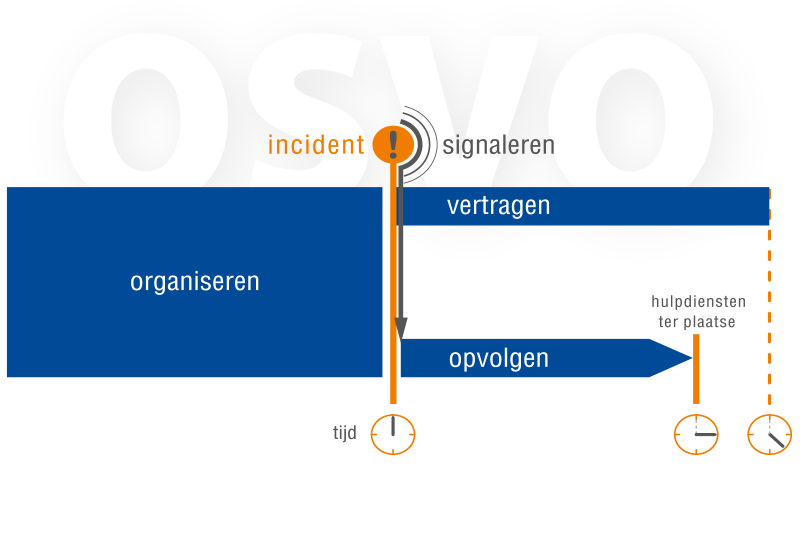
A good security solution consists of cohesive measures. The OSVO model helps to structure these measures logically: organize, signal, delay, and respond.
The perimeter forms the outermost layer of this security concept. In this layer, signaling and delaying come together. A threat is detected early, while physical measures create time for verification and response.
Physical perimeter detection
Fence Detection
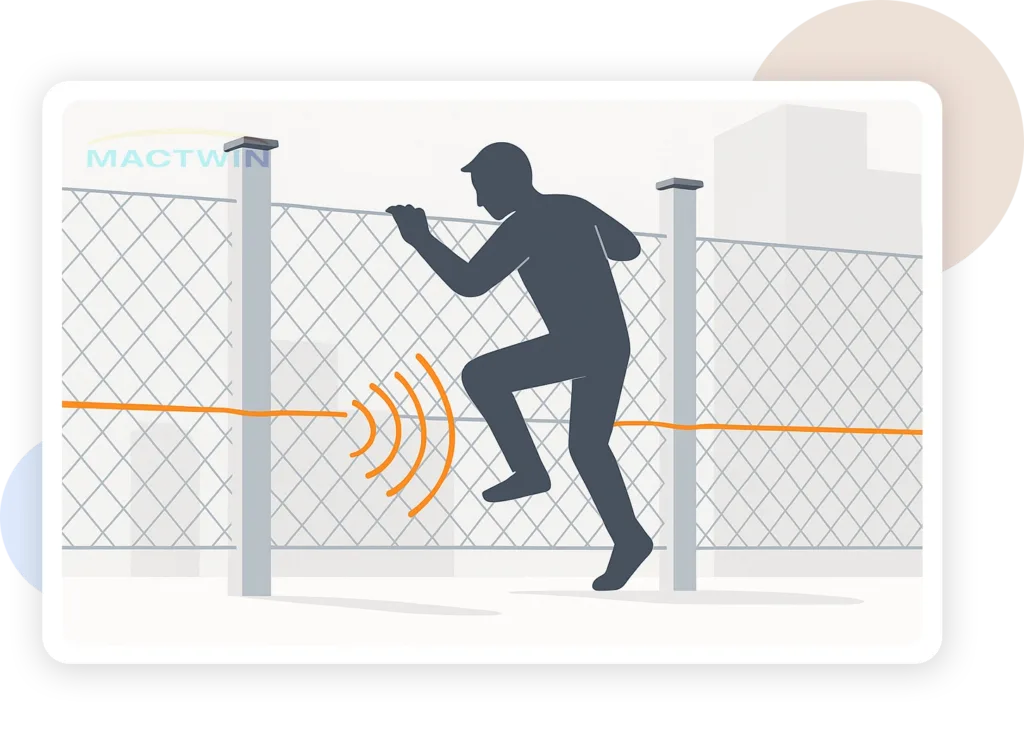
Fence detection turns a physical site barrier into an active detection layer. Sensors on or along the fence register vibrations, deformation, cutting, climbing, or other attempts to breach the perimeter. As a result, unauthorized access is not only signaled at the building, but already at the outermost layer of the site.
Advantages
- Precise detection along long fences
Disadvantages
- Sensitive to wind, rain, and vandalism
Ground Detection
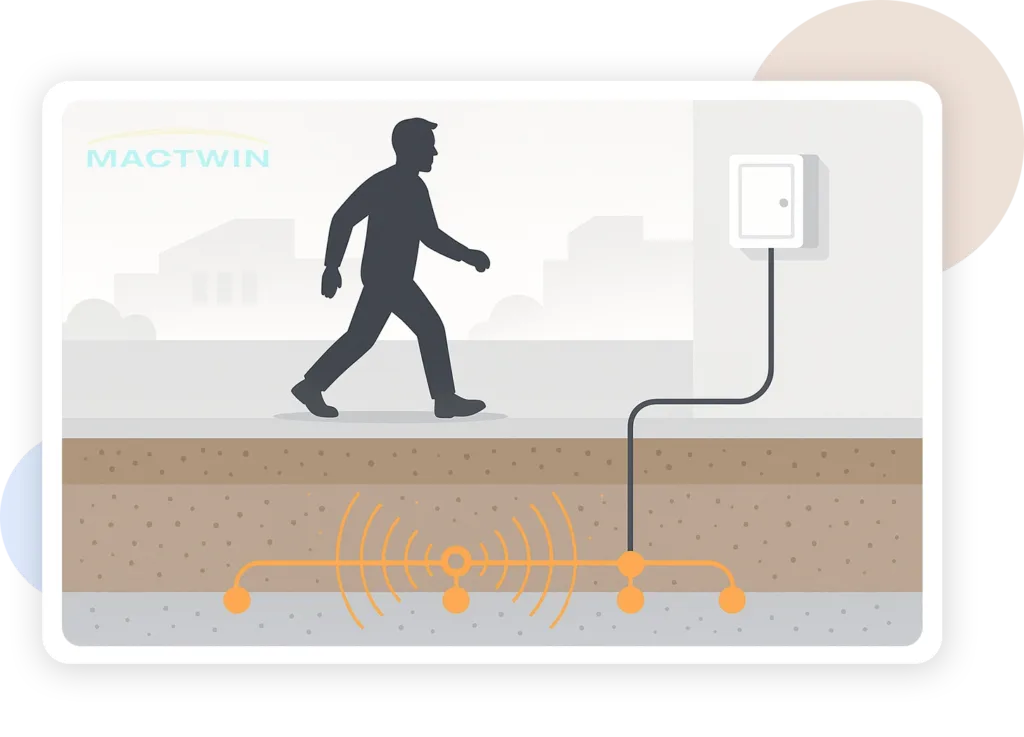
Invisible and extremely effective: underground detection systems recognize pressure differences or vibrations that occur when someone moves across the site. They work with pressure mats, liquid-filled hoses, or vibration sensors.
Advantages
- Completely invisible and resistant to sabotage
- Works on virtually any surface
- Insensitive to weather influences
Disadvantages
- Higher installation costs due to excavation work
- Sensitivity must be well-tuned to environmental vibrations (truck traffic, railway lines)
Achieve more with LiDAR
LiDAR is a relatively new method of detection for the security industry. LiDAR detection makes it possible to create a detailed 3D representation of an environment, independent of weather and light conditions. High-frequency scanning creates a real-time live view.
Then, similar to Video Content Analysis, the 3D data is analysed for detecting, identifying, and tracking objects. Information processed by a LiDAR sensor can not be used to identify a person, the data consists of information related to sensed distance and position.


Ask your question to our experts
In case of any questions, our staff is here to help. They will gladly make your wish into a suitable solution.